Exchange Traded Funds (ETFs) have emerged as a cornerstone for diversified investment portfolios, attracting both nascent retail investors and seasoned portfolio managers alike. Their cost-efficiency and broad market exposure make them an appealing option for long-term wealth accumulation.
This guide offers a clear, step-by-step methodology for acquiring ETFs through DEGIRO, a prominent online brokerage platform. Understanding the process of purchasing ETFs on DEGIRO is essential for effective portfolio management and informed decision-making.
Navigating ETF Selection and DEGIRO's Offering
ETFs are investment funds that hold assets such as stocks, bonds, or commodities, trading on stock exchanges like individual stocks. They offer immediate diversification across various market segments, often at a lower expense ratio compared to traditional mutual funds.
This inherent characteristic makes them attractive for achieving broad market exposure with minimal administrative burden. DEGIRO provides a robust platform for ETF trading, with many ETFs available for a flat €1 fee when traded via Tradegate, depending on the product and order conditions.
Before any acquisition, comprehensive research is paramount. Investors should evaluate an ETF's underlying index, geographical focus, sector allocation, expense ratio (TER), and tracking error. Understanding these metrics ensures alignment with personal financial goals and risk tolerance.
The Key Investor Information Document (KIID or KID) provides crucial details for informed decision-making regarding the ETF's structure and risks.
Step-by-Step Guide to Purchasing ETFs on DEGIRO
Initiating an ETF purchase on DEGIRO begins with ensuring your account is adequately funded. Once capital is available, navigate to the search bar within the DEGIRO platform. Here, investors can locate their desired ETF by entering its name or, more reliably, its International Securities Identification Number (ISIN) or Ticker Number.
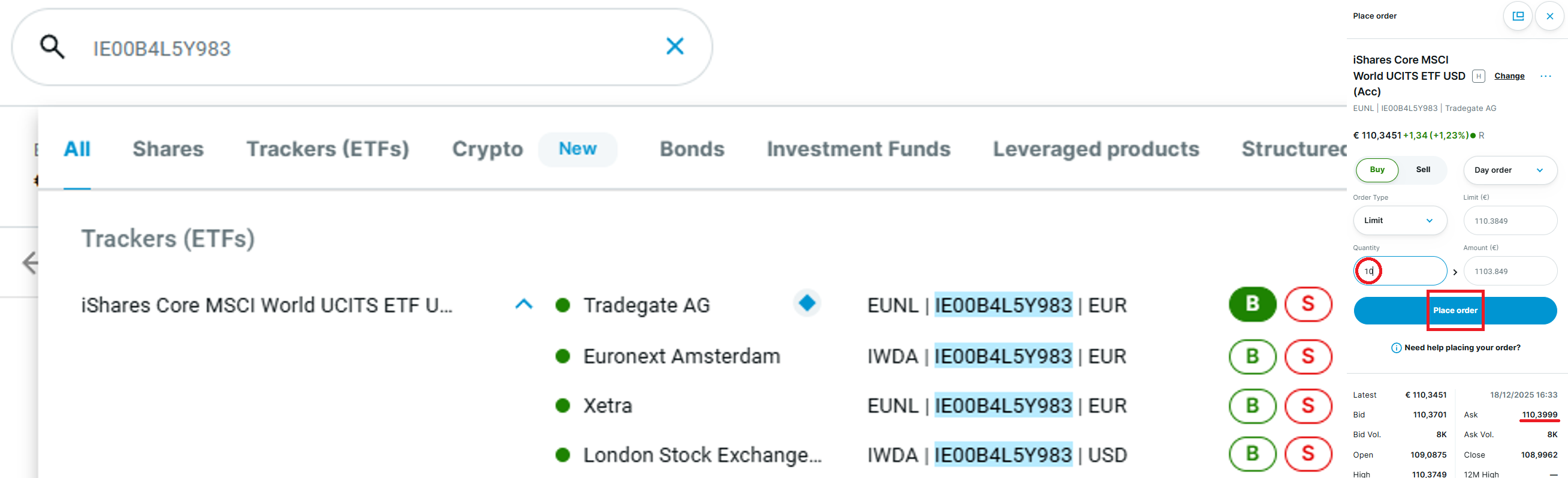
Instructions (see image at the top of the page):
Only during Market hours
For the best price (lowest spead costs).Search by ISIN or ticker symbol
Enter the ISIN or ticker code (e.g. IE00B4L5Y983) in the search bar, as shown in the image at the top of the page.Select “B” (Buy)
Choose the correct exchange and click the B (Buy) button, as illustrated in the image.Use the Ask price and enter quantity
Click on the Ask price and enter the number of shares you wish to buy, following the example in the image.Place the order
Review the order details and click “Place order” to submit the transaction, as indicated in the image above.
Upon locating the specific ETF, proceed to the order entry screen. This interface requires the investor to specify the number of units to purchase and the preferred order type. Common order types include 'Market Order', 'Limit Order', and 'Stop-Limit Order'.
For novice traders, a 'Limit Order' is generally recommended, as it allows setting a maximum purchase price, thereby preventing execution at an undesirable valuation. A 'Market Order', conversely, executes at the best available price instantly but offers less price control.
After defining the order parameters, review all details carefully, including the total estimated cost and any applicable fees. It is crucial to verify that the chosen ETF and quantity match the investment intent. Finally, confirm the order submission.
DEGIRO will typically provide an order confirmation, and the transaction will appear in the portfolio once executed within market hours. Monitoring market hours is important for timely order execution, as orders placed outside these times will be queued.
Key Takeaways
ETFs offer cost-effective diversification and broad market exposure for various investors.
DEGIRO provides access to a wide range of ETFs, many of which can be traded for a flat €1 fee via Tradegate, helping to optimize transaction costs.
Thorough research, including a review of the KIID/KID, is essential for informed decisions.
Utilizing 'Limit Orders' is often advisable for new investors to maintain price control during acquisition.
Disclaimer: This article may have been generated with AI assistance and is for educational and informational purposes only. It does not constitute financial, investment, or trading advice. Always consult with a qualified financial advisor before making investment decisions.